

An online store does not depend solely on design, catalog, or product pricing. It also relies on something less visible, but crucial: the technical infrastructure. If a page takes too long to load, if the cart freezes, or if the server fails during a campaign, the user usually does not wait. They close the website, look for another option, and the sale is lost.
That’s why choosing good hosting is a strategic decision for any ecommerce. Initially, shared hosting may be sufficient for a small store. But as visits increase, the catalog grows, payment methods are added, and campaigns bring more traffic, a more stable solution is needed. At that point, a VPS can offer better performance, more control, and greater growth capacity.

Why Does Speed Matter So Much in Ecommerce?
Loading speed directly affects the buyer's experience. A slow product page raises doubts. An internal search engine that responds late complicates navigation. A checkout that keeps loading may cause the customer to abandon the order just before paying.
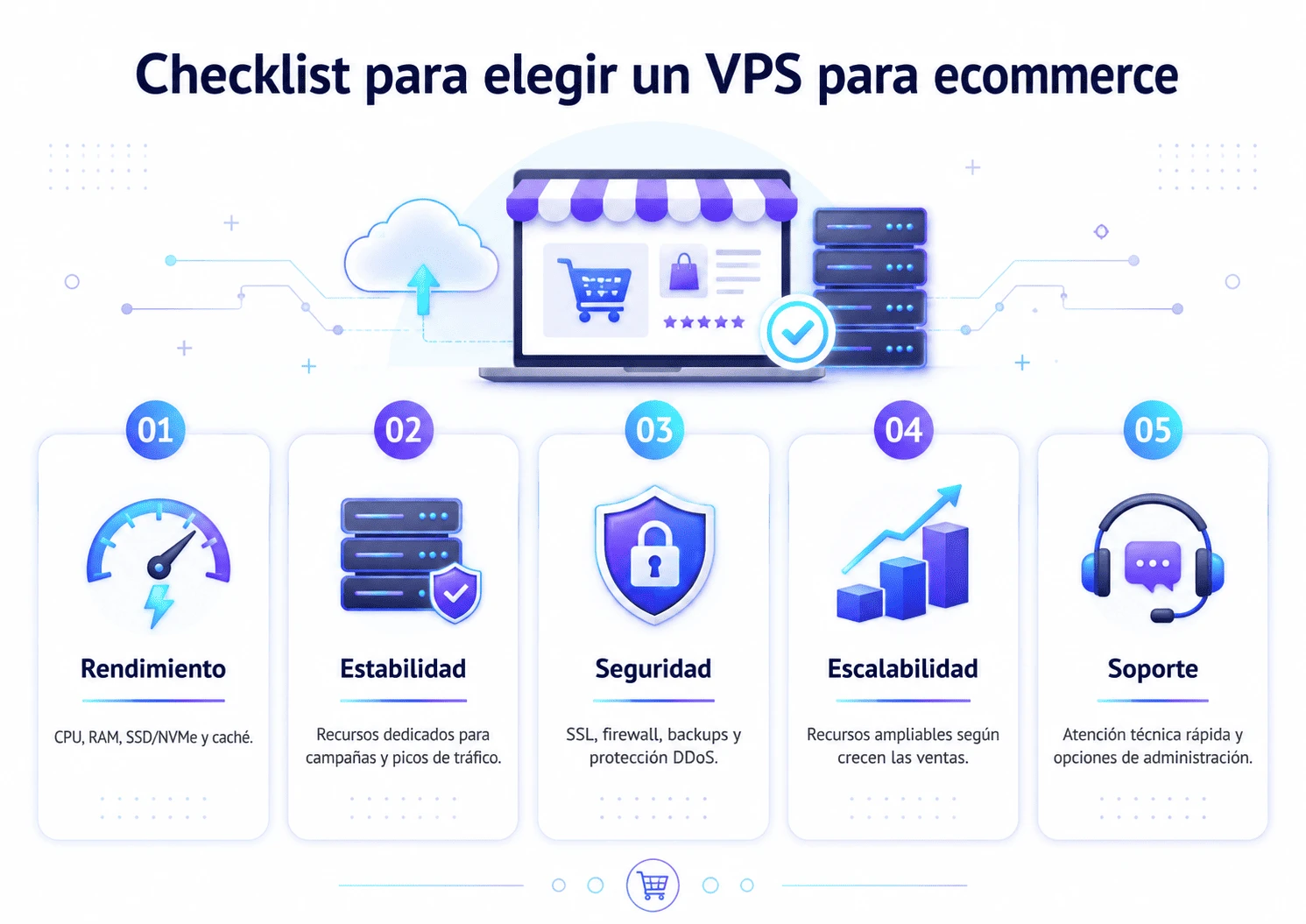
A VPS server allows for more predictable resources than shared hosting. The store has a defined amount of CPU, RAM, and storage, which helps maintain more stable operation. This is important on platforms like WooCommerce, PrestaShop, or Magento, where the database, cache, and server configuration significantly influence final performance.
What Should the Technical Infrastructure Provide?
The infrastructure of an online store must perform well at three key moments: daily browsing, sales peaks, and payment processes. It is not enough for the website to function on a quiet day. It must also remain stable when traffic comes from ads, newsletters, social media, or seasonal campaigns.
In this context, choosing a VPS hosting for ecommerce allows for a more controlled environment, where resources do not depend on other projects hosted on the same shared server. This reduces the risk of saturation, improves cart stability, and facilitates technical adjustments according to the actual needs of the store.
It is also advisable to check the server location. If the main audience is in Spain or other European countries, nearby infrastructure helps reduce latency. Additionally, it is recommended to consider SSD or NVMe disks, caching options, backups, and flexibility to adapt the environment to the CMS used.
Data and Payment Security in an Online Store
An ecommerce manages personal data, addresses, orders, and payment operations. Therefore, security cannot be treated as an add-on. A VPS offers more control over the environment and allows for measures such as firewalls, secure access, SSL certificates, monitoring, and scheduled updates.
It is also important to check if the provider offers protection against DDoS attacks and backup systems. A security incident not only affects the store's operation. It can also damage customer trust and the brand's reputation.
Can the Server Grow with the Store?
An ecommerce can grow irregularly. It may have quiet months and suddenly receive a lot of visits during Black Friday, Christmas, sales, or a specific campaign. If the server does not keep up with that growth, commercial success can turn into a technical problem.
The advantage of a VPS is that it allows for easier resource expansion. More memory, more processing, or more storage can help keep the store active when demand increases. This avoids urgent migrations and blockages at critical moments.
Support and Administration
Not all stores have their own technical team. Therefore, before hiring a VPS, it is advisable to review the level of support, the language of assistance, response times, and whether there are management options.
Choosing a VPS for ecommerce should not be based solely on the monthly price. Performance, security, scalability, server location, and support are factors that directly influence sales, trust, and business continuity.

You may also like


